
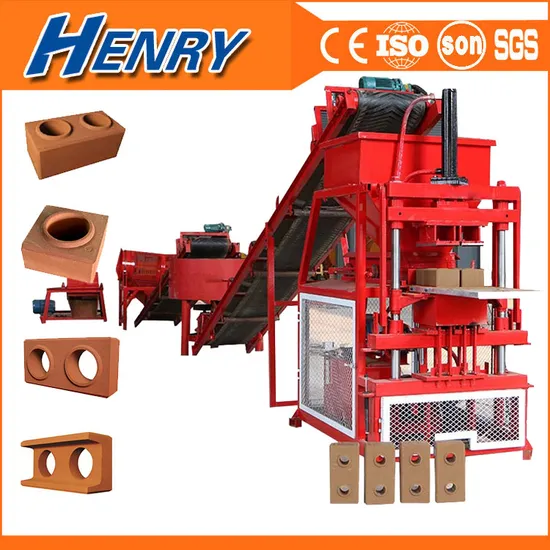
Production line and factory setup overview
This proposal outlines a modular automatic brick production plant for interlocking compressed-earth blocks or fired clay bricks. The recommended first phase emphasizes locally available soil, clay, sand and cement, controlled dosing, hydraulic forming, low labor demand and replaceable molds. A fired-clay configuration can be added where market volume and fuel economics justify dryers and a tunnel kiln.
Recommended lowest-entry line configuration Automatic hydraulic interlocking-brick line with mixer, conveyor, 16 MPa press, interchangeable molds and palletized curing; designed around 4,500-8,000 pieces per 8-hour shift.
Production process and implementation sequence
- Raw material prep
- Batch dosing
- Mixing
- Hydraulic forming
- Curing or drying
- Inspection
- Palletizing
Products, capacity and market fit
- Rapid housing and commercial construction creates recurring demand for walling units.
- Local soil and aggregates can reduce dependence on imported finished materials after laboratory validation.
- Interlocking products can reduce mortar use and accelerate construction.
- Replaceable molds allow hollow, solid, paver and interlocking formats from one production base.
- Interlocking soil block - Typical 300 x 150 x 100 mm - Housing and boundary walls
- Hollow masonry block - Custom mold and wall thickness - Residential and commercial
- Solid clay brick - Fired option with dryer and kiln - General construction
- Paving block - Colored or natural finish - Roads, yards and landscaping
Core production machinery and line specifications
| Machine / stage | Function / value | Production note |
|---|---|---|
| Soil crusher and screen | Break lumps and control feed size | Matched to local soil |
| Aggregate bins | Store and proportion soil, sand and stabilizer | 2-4 compartments |
| Pan or twin-shaft mixer | Homogenize dry ingredients and water | JQ350 class or larger |
| Belt conveyor | Transfer prepared mix | Variable speed |
| Hydraulic brick press | Compact material in replaceable molds | 16 MPa; 7-10 s cycle |
| Mold sets | Create selected brick geometries | Hardened replaceable tooling |
| Pallet conveyor | Move green bricks without deformation | Automatic indexing |
| Curing area | Maintain moisture for stabilized products | 7-28 day plan |
| Stacking system | Handle cured bricks | Manual or robotic |
| QC equipment | Check dimensions and compression | Scale, caliper, compression tester |
Raw materials, utilities and factory requirements
- Tested clay or lateritic soil
- Sand or stone fines as formulation requires
- Portland cement for stabilized blocks
- Clean process water
- Pigments and additives for specialty products
- Three-phase power sized after equipment selection
- Process and curing water storage
- Covered raw-material preparation area
- Level production floor and forklift access
- Dust extraction at crushing and screening
Indicative low-entry investment and implementation plan
These planning ranges prioritize economical machinery, local labor and local civil works. Final pricing follows confirmed capacity, product specification, delivery terms and site conditions.
| Scope | Indicative range | Entry-plan note |
|---|---|---|
| Core machinery | US$12k-45k | Entry Chinese mixer, press, molds and basic conveyors |
| Local civil works and utilities | US$8k-25k | Simple local shed, floor, wiring and curing area |
| Freight, installation, training | US$8k-25k | Containerized equipment and remote support where practical |
| Working capital | US$8k-20k | Materials, pallets, labor, testing and launch stock |
| Low-entry project total | US$36k-115k | Land excluded; manual handling can reduce the starting cost |
Detailed proposal and next step
The proposal contains the complete line flow, machinery scope, raw-material and utility requirements, implementation stages and indicative entry planning. Final configuration follows confirmed products, capacity, site and budget.