
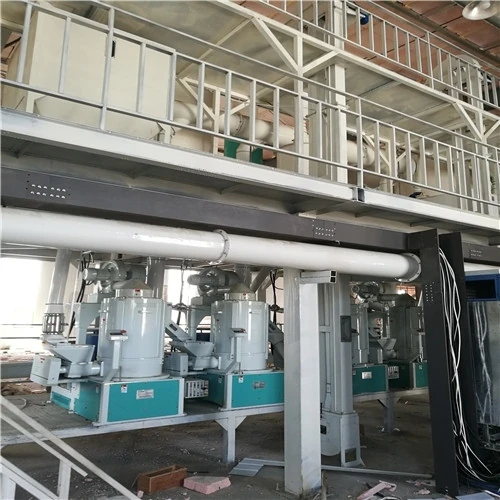
Production line and factory setup overview
A small cleaning, destoning, abrasive dehulling, aspiration, polishing and grading line for food-grade pearl barley.
Recommended lowest-entry line configuration Start at 300-500 kg/h with a cleaner, destoner, adjustable dehuller/pearler, aspiration, grading screen and semi-manual packing.
300-500 kg/hstarter barley input
70-85%planning pearled-product yield
12-25 kWindicative connected load
3-5entry operators
Production process and implementation sequence
- Food-grade barley intake and grading
- Air-screen cleaning and magnetic protection
- Destoning and size classification
- First controlled dehulling or pearling pass
- Aspiration of hull, bran and flour dust
- Optional second pearling and polishing pass
- Whole and broken-kernel grading
- Weighing, bag sealing and lot coding
Products, capacity and market fit
- Afghan barley can be converted into a convenient food ingredient with shorter cooking time.
- A compact line can serve retail packs, soup makers, restaurants and institutional kitchens.
- Adjustable pearling supports lightly pearled and more polished grades from one plant.
- Separated hull and bran may be sold to approved feed users after contamination checks.
- Pearl barley - Uniform polish, low hull residue and buyer-approved cooking time - Retail, soup, restaurant and institutional food
- Lightly pearled barley - Controlled partial bran retention - Whole-grain and specialty food buyers
- Broken pearled barley - Clean graded smaller-kernel fraction - Porridge, flour and food-ingredient users
- Hull and bran fraction - Dry separated co-product - Approved livestock-feed users
Core production machinery and line specifications
| Machine / stage | Function / value | Production note |
|---|---|---|
| Air-screen cleaner and magnet | Removes dust, chaff, over/undersize and ferrous material | Screens matched to local barley |
| Destoner | Separates stones and dense impurities | Adjustable deck and aspiration |
| Size grader | Improves uniformity before abrasion | Separate undersize and broken grain |
| Adjustable barley pearler | Removes hull and selected bran by controlled abrasion | Variable clearance or pressure; low broken-kernel target |
| Aspiration and cyclone | Separates hull, bran and flour dust | Dust-tight ducts and identified discharge |
| Optional polishing pass | Produces a smoother and more uniform kernel | Use only to buyer-approved pearling degree |
| Product grader | Separates whole pearl barley and broken fractions | Interchangeable food-grade screens |
| Scale and bag closer | Packs released products and co-products | Semi-manual 1-25 kg starter range |
Raw materials, utilities and factory requirements
- Food-grade Afghan barley approved for pearling
- Food-grade retail or wholesale bags
- Labels and coding consumables
- Approved sanitation and pest-control materials
- Stable three-phase electricity
- Dust extraction and safe ventilation
- Dry barley and finished-product storage
- Calibrated scales, moisture meter and laboratory screens
- Food-hygiene and pest-control program
Indicative low-entry investment and implementation plan
These planning ranges prioritize economical machinery, local labor and local civil works. Final pricing follows confirmed capacity, product specification, delivery terms and site conditions.
| Scope | Indicative range | Entry-plan note |
|---|---|---|
| Cleaning, destoning and grading | US$3k-7k | Compact food-grain preparation |
| Adjustable pearling and aspiration section | US$3k-9k | One pearler with cyclone and wear parts |
| Product grading and semi-manual packing | US$2k-6k | Whole and broken launch grades |
| Electrical, installation and initial spares | US$1.5k-4k | Include abrasive parts, screens and belts |
| Freight and clearance | US$2k-5k | Compact consolidated shipment |
| Indicative low-entry total | US$11.5k-31k | Building, barley stock and color sorter excluded |
Detailed proposal and next step
The proposal contains the complete line flow, machinery scope, raw-material and utility requirements, implementation stages and indicative entry planning. Final configuration follows confirmed products, capacity, site and budget.